 info@flexby.eu


On 28–29 May 2026, Barcelona brought together around 40 researchers, industry representatives and policymakers for two days of insightful discussions on a shared challenge: how to turn waste into sustainable fuels at scale.
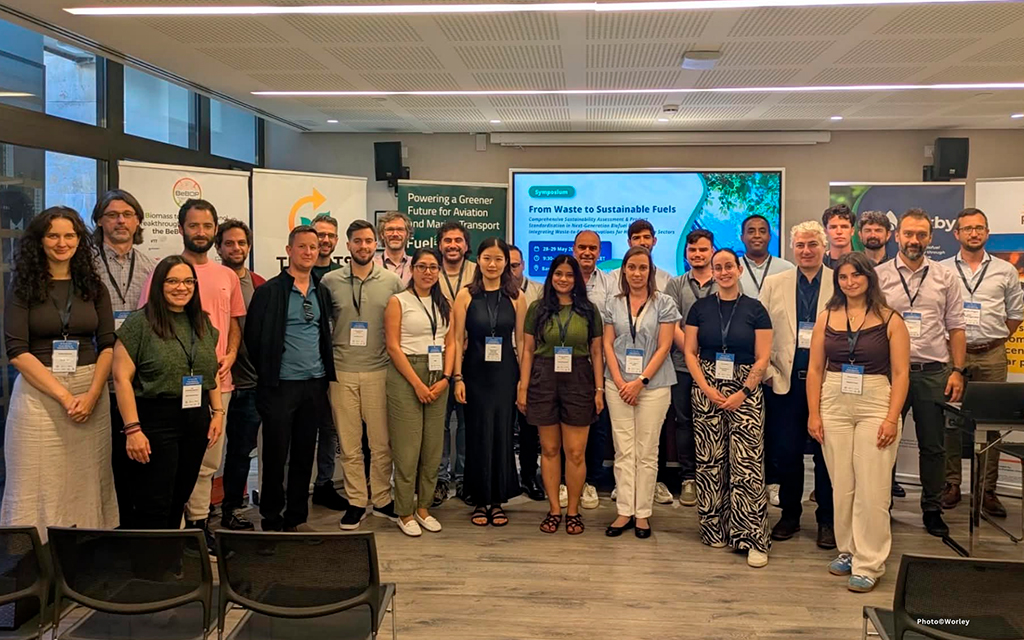
Across the symposium, participants explored a wide range of topics, from Life Cycle Assessment (LCA) and circularity metrics to artificial intelligence, techno-economic analysis and advanced fuel pathways. Discussions highlighted the diversity of technological solutions available and the opportunities for transforming waste and biomass resources into sustainable fuels.
A key highlight of the first day was the panel discussion “Aligning LCA Methodology for (Bio)Fuels: From Standards to Advanced Considerations”, moderated by Thomas Schaubroeck, Lead Researcher and Sustainability Expert at the Luxembourg Institute of Science and Technology (LIST). The session featured a keynote presentation by Jannick Schmidt, Professor at Aalborg University and CTO of 2-0 LCA, followed by an engaging Q&A and brainstorming session. Participants exchanged perspectives and explored approaches to the topics presented by Jannick Schmidt and Thomas Schaubroeck, reflecting on their relevance to ongoing research and innovation projects.
The discussions underlined the importance of consistency and harmonisation in LCA methodologies when assessing the sustainability of (bio)fuels and enabling meaningful comparisons across different technologies and pathways.
The second day delved deeper into the technologies shaping the future of sustainable fuels, from negative-emission biofuels and biomass residues to e-fuels and advanced conversion processes. A roundtable discussion reflecting on the symposium's key insights was moderated by Prof. Fausto Gallucci, Senior Consultant at 1 CUBE, and featured contributions from Marco Binotti, Associate Professor at Politecnico di Milano, and Marcin Siedlecki, Head of RIC’s Biomass and Waste Valorisation Laboratory. The exchange offered an opportunity to reflect on the challenges, opportunities and next steps for advancing sustainable fuel technologies.
An important takeaway from the FLEXBY Clustering Workshop was the value participants placed on learning about the different approaches, methodologies and tools being developed and applied across projects. This was particularly evident in discussions on LCA, where participants appreciated the opportunity to exchange experiences on simulation tools, product valorisation strategies and the development of future scenarios. These exchanges highlighted the benefits of bringing projects together to share knowledge, compare methodologies and identify potential synergies.
The conversations reinforced a central message: scaling sustainable fuel solutions requires more than technological innovation. It requires alignment, collaboration and knowledge-sharing across sectors, projects and value chains.
With strong engagement, new connections and a shared ambition to accelerate the transition from research and innovation to implementation, the symposium provided an important platform for advancing sustainable fuel solutions in Europe. It also demonstrated the importance of clustering activities in connecting European projects, fostering cross-project learning and supporting the development of more coherent approaches to sustainability assessment and technology deployment.
A huge thank you to everyone who helped make the event a success, to our speakers and panellists for their valuable contributions, to all participants for their active engagement, and to our co-organising projects: BeBOP, Bio-MeGaFuel, Fuel-Up, Fuels-C, PYSOLO and TEAPOTS.
Learn more about FLEXBY’s networking activities.